
USC Upstate Graduate Business Analytics Enterprise Project Sequence
| Program Overview | ||
|---|---|---|
| Program Title | USC Upstate Graduate Business Analytics Enterprise Project Sequence | |
| Organization | University of South Carolina - Upstate | |
| # of Students Enrolled |
0
|
|
| # of Projects Running |
1 Project/s Added (of 3 Projects Expected)
|
|
|
Program Timeline Project Duration |
Start Date: 08/17/26 End Date: 12/11/26 4 months |
|
| Collaboration Overview | ||
|---|---|---|
| About Students |
Students participating in this program are graduate-level learners in the University of South Carolina Upstate’s graduate business analytics program. They are preparing to become analytics professionals who can work across business functions, translate data into decisions, and support enterprise-wide decision-making. The program gives students exposure to analytics as it is actually practiced inside organizations. Faculty described the goal as helping students understand how analytics is used across different business functions, including descriptive, predictive, and prescriptive analytics, while emphasizing data quality, data cleaning, strategic alignment, and the connection between analytics and competitive advantage. Students may enter the program with varied levels of coding and technical experience. Some have strong business backgrounds and may be developing confidence with tools such as SQL, Python, dashboards, and AI-supported analytics. Faculty specifically noted that students often need to learn how to work with imperfect real-world data rather than clean classroom datasets. Across the sequence, students will work in teams and apply tools and methods such as data cleaning, data quality assessment, SQL, database concepts, dashboarding, data visualization, predictive analytics, AI-enabled workflows, statistical analysis, and executive communication.
Student Level: Graduate Degree Student Time Commitment: Full Time Team Structure: 4 - 6 |
|
| Program Goals | Through this Enterprise Analytics Consulting Sequence, students will:
|
|
| Format Structure |
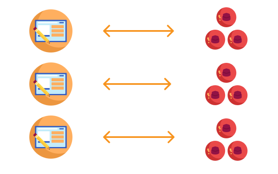
Multiple Projects Multiple Teams |
|
| Format Title | Enterprise Analytics Consulting Sequence | |
| Format Description | The Enterprise Analytics Consulting Sequence is a multi-course, project-based consulting experience designed to connect graduate business analytics students at the University of South Carolina Upstate with an organization seeking meaningful support on a substantial data, analytics, business intelligence, or AI-enabled decision-making initiative. Unlike prior short-format analytics capstones, this model is designed around one significant industry partner project that can be used across several courses in the graduate business analytics curriculum. The goal is to give students a more complete view of how analytics functions across an enterprise, from strategy and data quality to database design, visualization, predictive modeling, and final consulting recommendations. The program is especially well suited for organizations that have a meaningful business data challenge, a sizable dataset or data environment, and a desire to turn raw information into actionable insight. Strong projects may involve ERP data, operational data, financial data, customer data, manufacturing data, supply chain data, sales data, service data, or other business datasets that can support multiple layers of analysis. Across the course sequence, students may help the partner organization understand business goals, assess data quality, clean and prepare data, define a data dictionary, explore database or data warehouse requirements, build dashboards, develop analytics outputs, identify KPIs, test predictive or prescriptive models, and translate findings into strategic recommendations. The experience is intended to mirror the realities of enterprise analytics work. Students will learn that analytics does not begin with a clean dataset wrapped neatly for analysis. Instead, they will engage with the practical challenges organizations face when building analytics capacity, including messy data, unclear reporting needs, system limitations, stakeholder priorities, data governance, and the need to align analytics work with business strategy. The structure allows multiple faculty members to use the same company project across different courses, where appropriate. Potential course connections may include principles of business analytics, quantitative methods, predictive analytics, data visualization, database management, AI-enabled analytics, and the final capstone. USC Upstate faculty noted that the goal is to “wrap their hands around one major” company project and create value through as many courses as possible, while recognizing that individual faculty will determine how the project fits into their courses.
|
|
| Benefits For Industry Partners | Participating organizations gain access to a graduate business analytics program that can provide sustained attention to a substantial data and business intelligence challenge.
Industry partners benefit through:
Enterprise-Wide Analytics Perspective Rather than receiving a short, isolated capstone project, partners can engage with a course sequence designed to examine the project from multiple angles, including strategy, data quality, database structure, visualization, predictive analytics, and business recommendations.
Support for Data Readiness and Data Quality Students can help examine raw or semi-structured business data, identify quality issues, document missing values or inconsistencies, and recommend practical steps to improve data usability.
Business Intelligence and Dashboard Development Projects may include dashboard concepts, KPI development, reporting structures, and data visualization outputs that help stakeholders make better use of operational, financial, customer, or ERP data.
Predictive and Prescriptive Analytics Exploration Where data quality and project scope allow, students can test analytical models, explore trends, identify patterns, and evaluate potential decision-support use cases.
Strategic Alignment Students are trained to connect analytics projects to business strategy, competitive advantage, and organizational goals rather than treating data analysis as an isolated technical exercise.
Talent Pipeline Development Partners gain early access to graduate analytics students who are preparing for professional roles in business intelligence, analytics, data strategy, operations analytics, finance analytics, and AI-enabled decision support.
Low-Cost, High-Value Collaboration
The program is non-sponsored unless otherwise stated. Industry partners contribute time, context, data access, and feedback while USC Upstate faculty guide student learning and course integration. |
|
| Project Modality | Fully Remote | |
| Industry Partner Requirements to Participate | ||
|---|---|---|
| Project Topics | Artificial Intelligence & Machine Learning Data Management Innovation Operations Reporting, Financial Planning & Analysis Research, Analysis, Evaluation Software Design & Development Strategic Planning | |
| Target Industries | Aerospace & Defense Agriculture & Farming Arts & Recreation Biotech & Pharmaceuticals Computers & Hardware Construction, Repair & Maitenance Consulting & Professional Services Consumer Products & Services Education & Ed-Tech Energy & Utilities Fashion & Apparel Finance & Investment Food & Beverage Government Health Care & Life Sciences Insurance Manufacturing & Industrial Media, Publishing & Content Natural Resources Non-Profit & Social Impact Public Works Real Estate Restaurants, Bars & Food Services Retail & E-Commerce Semiconductor Software, AI & Data Sports & Entertainment Sustainability & Climate Telecommunications Transportation & Logistics Travel & Tourism | |
| Skills & Expertise | AI-Assisted Analytics Business Analytics Business Intelligence ChatGPT Prompt Engineering Dashboard Design Data Cleaning Data Dictionary Development Data Integrity Data Quality Assessment Data Storytelling Data Strategy Data Visualization Data Warehouse Planning Database Design Descriptive Analytics Domo Enterprise Analytics ERP Data Analysis Executive Presentation Development Exploratory Data Analysis KPI Development Power BI Predictive Analytics Prescriptive Analytics Python Programming Regression Analysis SQL Querying Stakeholder Communication Statistical Analysis Strategic Decision Support Tableau Team-Based Problem Solving Workflow Automation | |
| Location Information & Preferences |
Located Anywhere Preference should be given to U.S.-based organizations with substantial business datasets and the ability to collaborate virtually. Regional partners may be considered if an in-person or hybrid relationship is valuable, but location is less important than project fit, dataset depth, and partner commitment.
|
|
| Sponsorship |
Sponsorship Requested (Optional): |
|
| Compensation |
No Compensation Required |
|
| Other Requirements | Participating organizations should be prepared to:
Projects should not be limited to a small spreadsheet or narrow one-off analysis. Faculty specifically emphasized that a small dataset, such as a basic spreadsheet with 1,000 rows, would not be sufficient for this revised structure. The program needs a significant enough data environment to support multiple courses and multiple layers of analytics work. If the project involves sensitive data, the partner should be prepared to use an NDA and provide clear rules for data access, storage, use, and deletion. In the example discussed, the company noted that students would sign a standard NDA before working with source data, and USC Upstate faculty emphasized that NDA compliance would be taken seriously with students.
|
|
| Expected Time Commitment For Project Managers | 1 Hour per week | |
| Key Program Dates | Due Date |
|---|---|
|
Request for Proposal published
Collaboration request published. Industry Partners may express interest in participating.
|
Aug 05 2026, 03:58 PM UTC |
|
Interview
Educators will begin interviewing interested Industry Partners to discuss project ideas.
|
Aug 06 2026, 03:58 PM UTC |
|
Proposal Application Deadline
Final date for Industry Partners to express interest in participating.
|
Aug 13 2026, 03:58 PM UTC |
|
Finalize Project Charter
Educators and Industry Partners finalize project charters, legal documents, and background materials.
|
Aug 14 2026, 03:58 PM UTC |
|
Official Program Launch
We’ll find a time on this day for you to meet with the students to kick off your project.
|
Aug 17 2026 |
|
Official Program End
We’ll find a time on this day for you to meet with the students to wrap up your project.
|
Dec 11 2026 |
Program Timeline
|
Due Date
|
Activities |
Deliverables
|
Status
|
Action | |
|---|---|---|---|---|---|
|
Mon, 08/17/26
|
Program Kickoff
|
No Deliverables
No deliverables are required for this action item.
|
|||
|
Location:
|
|||||
Projects
Filters
| Project | Organization | Topics |
|---|---|---|
| ClearFracture.ai AI Agent Performance Analysis Project | Clear Fracture | Artificial Intelligence & Machine Learning Data Management Research, Analysis, Evaluation |
Program Managers
| Name | Organization |
|---|---|
| Jingyun Hu | University of South Carolina - Upstate |
Teams
| Team Name | Project Name | Team Members |
|---|---|---|
| No Teams Available |